


2027 Rates
After offering particularly low energy rates in recent years, SEIC has had to raise its energy rates in line with changes in market prices.
The other components of the electricity price are adjusted only slightly, or remain stable.
Electricity Rate Adjustments for 2027
SEIC customers' electricity bills will see a rate adjustment in 2027, primarily due to rising energy prices.
For example, a household in Gland that consumes 2,500 kWh per year (a 4-room apartment) and is on the SEIC Mix dual-rate plan will see its bill increase by approximately 7% in 2027. The monthly bill will rise from CHF 69 in 2026 to CHF 74 in 2027 (excluding VAT), an increase of about CHF 5 per month.
The price per kWh consumed consists of the cost of the energy, transmission charges (transmission fee), and taxes and fees levied on electricity. Added to this is the metering fee, which is a flat monthly charge.
Rise in Energy Rates
After offering particularly low energy rates in recent years, SEIC has had to adjust its energy rates, which will increase by 17% in 2027 across all rate categories—amounting to just under CHF 4.00 per month for a household that consumes 2,500 kWh annually.
This trend is primarily due to a significant increase in procurement costs. To ensure price stability, SEIC meets most of its energy needs through long-term purchase contracts on European markets, some of which had to be renewed. These contracts are supplemented by daily purchases on the power exchange to supply energy volumes that closely match actual consumption.
However, consumption forecasts have become highly uncertain due to the increase in photovoltaic generation, which is extremely sensitive to weather conditions. As a result, the so-called “balancing” energy—which is necessary to maintain the stability of electric grids—is in greater demand, and its cost directly impacts rates.
While electricity prices on the markets have stabilized, they have risen sharply in recent years, largely due to international geopolitical tensions.
In summary, procurement costs are rising to keep pace with price changes and to cover the energy needs for load balancing.
Adjustment of Transmission Rates
Grid access rates for 2027 will increase by 3 to 6 percent, depending on the rate category. This adjustment is necessary to cover the costs associated with implementing the new legal requirements related to the energy transition—in particular, the provisions set forth in the electricity laws enacted in 2024—as well as to strengthen the protection of critical electricity grid infrastructure against cyber risks.
Swissgrid’s system services will decrease by 30% in 2027, falling to 0.19 ct/kWh. Also included in the transmission charges on your bill, the electricity reserve fee will decrease by 59% to 0.17 ct/kWh, while the solidarity costs for the transmission grid will increase to 0.19 ct/kWh—a 280% rise. These three rates are set by Swissgrid and are paid in full to Swissgrid.
For a household that consumes 2,500 kWh per year, total transmission costs represent an increase of about 70 cts per month.
Pricing for the service remains unchanged
Introduced in 2026 to comply with new regulations and enhance cost transparency, these rates cover expenses related to the metering system—including meters and data management infrastructure. They remain unchanged in 2027, at CHF 6.75 per month for households.
Taxes and fees
Federal taxes, as well as those levied by the canton of Vaud and the municipalities, will remain unchanged in 2027. Please note that SEIC has no influence over the amounts of taxes and fees.
SEIC Mix or SEIC GreenEnergy Products
Without any specific request on your part, you receive the SEIC mix product , electricity produced from 70% Swiss renewable energy and 30% nuclear energy. From January 1, 2026, this product will replace the standard SEIC logic product.
If you want to benefit from electricity from 100% renewable sources, choose our SEIC green product, made up of electricity from hydraulic and solar sources.
Single rate vs. double rate
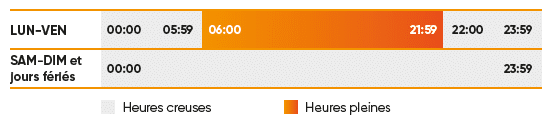
If your meter doesn't differentiate between on-peak and off-peak hours, you'll be billed according to the single-rate principle, which is ideal if you live in an apartment without a water heater or electric heating. You can also, if you wish, submit a request to change or adapt your meter to benefit from the double rate.
A double rate, on the other hand, is recommended if you can use off-peak hours for more than a third of your consumption. To check that your meters distinguish between peak hours (HP) and off-peak hours (HC), just glance at your bill! If the words "Consommation HP/HC" or "Chauffage HP/HC" appear, you're entitled to the double rate. If not, ask for it.
Composition of electricity prices
Electricity prices
Transmission Fees and Metering Rates
Taxes and fees
Please note that SEIC is not in a position to influence this component of the price. It is obliged to deduct these amounts and pass them on to the relevant bodies.
Where does the electricity you use come from?
Electricity sourcing information is official data that tells you the sources (hydroelectric, solar, nuclear, etc.) of the electricity you consume. It is reported annually for the electricity supplied in the previous year to provide you with greater transparency regarding the origin of the electricity supplied by SEIC.
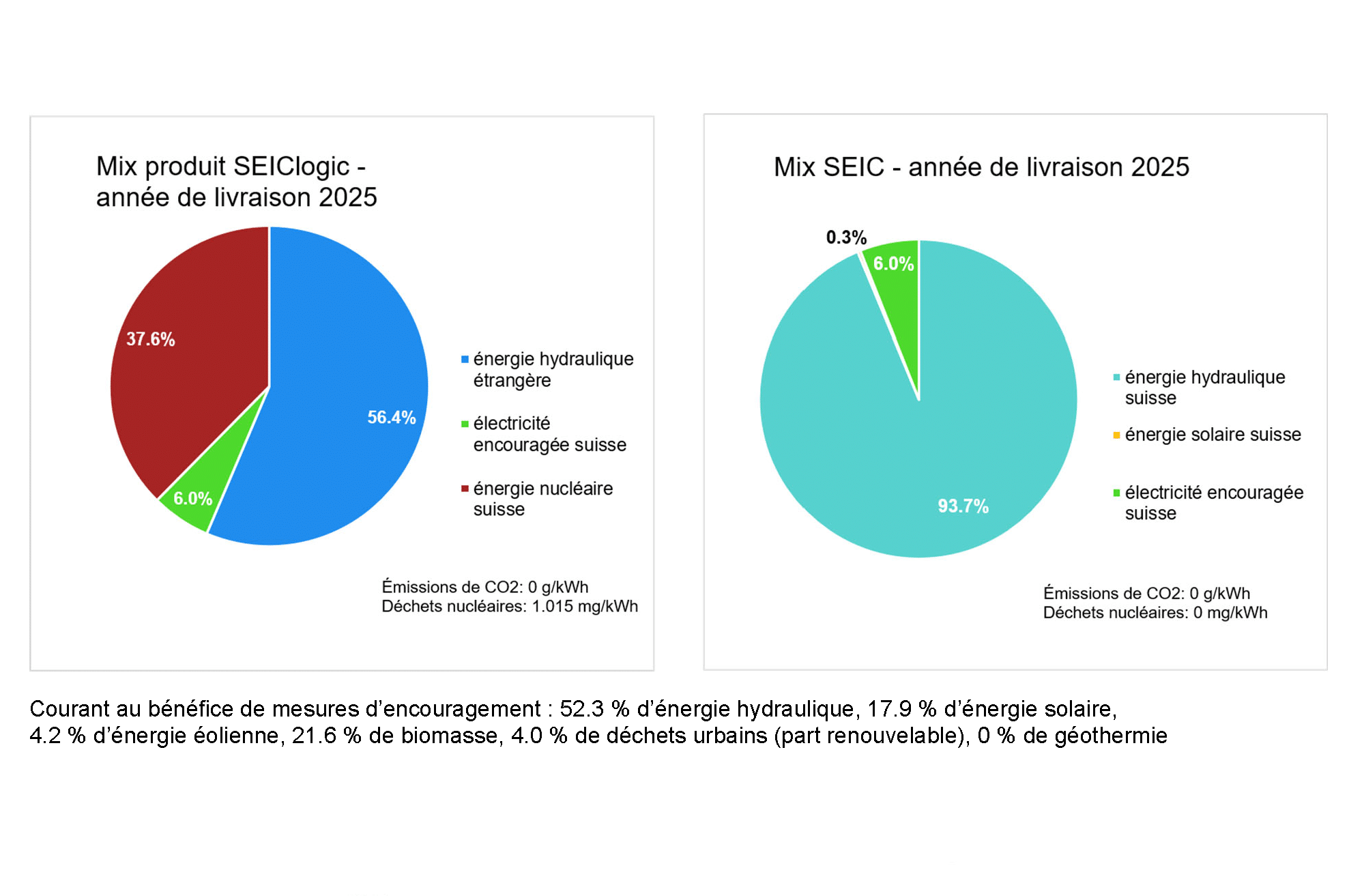
The electricity distributed by SEIC in 2025 will consist of 100% Swiss renewable energy.
The renewable energy supplied consists of:
- 93.7% of Switzerland's hydropower
- 0.3% of Swiss solar energy
- 6% of electricity generated through incentive programs*, consisting of: 52.3% hydropower, 17.9% solar power, 4.2% wind power, 21.6% biomass, 4.0% municipal solid waste (renewable portion), and 0% geothermal power.
*This national program to support electricity generation from renewable sources is funded by the cost-based feed-in tariff (RPC), to which you contribute through the “federal transmission network surcharge,” which was 2.30 cts/kWh in 2025.
Labeling 2025: New Information
Since 2026 (for the 2025 delivery year), in accordance with the new legal framework, the labeling specifies:
- the energy mix of the selected product
- SEIC's overall energy mix
- CO2 emissions and the amount of nuclear waste for each energy mix
Below is a comparison between the energy mix for the SEIClogic product—which was primarily distributed to you in 2025—and SEIC’s overall energy mix.
Labeling of Electricity Supplied in 2025
Check out our news section to learn about the labeling of other products to be delivered in 2025.
Guarantees of origin for electricity branding
A guarantee of origin is the official electronic certificate issued by Pronovo (the federal agency responsible for registering guarantees of origin) that identifies the source of the electricity consumed based on the generation technology used (solar, hydroelectric, nuclear, etc.) and the location of generation.
Since electrons cannot be tracked, these certificates are used to track the electricity supplied, under Pronovo’s supervision.
In 2025, a higher-than-expected volume of hydroelectric certificates of origin was incorporated. This situation provided an opportunity to promote electricity with high environmental quality, enabling SEIC to offer its customers a fully renewable supplier mix.
Documents to download
- 2027 Rate Schedule - Residential Customers (consumption of less than 50,000 kWh/year)
- 2027 Rate Schedule - Businesses (consumption of more than 50,000 kWh/year)
- Taxes for 2027
-
SEIC general terms and conditions for connection,
for use of the grid and supply of electrical energy - 2027 Rate Schedule in JSON Format